
Going to the gym sounds great in theory. In reality, between the commute, the membership fees, the crowded equipment, and the unpredictable weather, most people give up before they ever see results. The good news is that you do not need a gym to get fit. You never did.
The right home fitness gadgets give you everything a gym offers resistance, cardio, recovery without the hassle. And the best part? Most of them cost less than a single month of gym membership.
Here are 7 fitness gadgets that are genuinely worth buying, whether you are just starting out or looking to level up your home setup.
1. Elastic Resistance Band Set
If you could only buy one piece of fitness equipment, a resistance band set would be it. That is not an opinion it is what sports physiotherapists and personal trainers recommend to their clients worldwide.
Resistance bands provide variable tension throughout every movement, which means your muscles work harder at the right moments compared to fixed weights. They are suitable for every fitness level because the resistance increases as you stretch the band further, allowing complete beginners and advanced athletes to use the exact same set.
What you can train with bands:
- Bicep curls and tricep extensions for arms
- Squats, lunges, and glute bridges for legs
- Lateral band walks for hip stability
- Rows and pull-aparts for upper back
- Core exercises including Pallof press and anti-rotation holds
Why bands beat machines: Unlike gym machines that lock you into a fixed movement pattern, resistance bands let your joints move naturally. This reduces injury risk and builds functional strength you actually use in daily life.
A full set typically includes multiple resistance levels, light, medium, heavy, and extra heavy so you can progress gradually as you get stronger. They roll up to the size of a water bottle and weigh almost nothing, making them perfect for home, travel, and outdoor workouts.
2. Skipping Rope with Built-In Counter
Skipping is one of the most underrated forms of cardio in existence. Boxers have known this for over a century. A 10-minute skipping session burns roughly the same calories as an 8-minute mile run, while also improving coordination, footwork, and cardiovascular endurance.
A modern skipping rope with a built-in digital counter removes the guesswork. You can see exactly how many jumps you have completed, set targets, and track progress over time all without a separate app or device.
Benefits of skipping for fitness:
- Burns calories rapidly without joint impact comparable to running
- Improves cardiovascular health and lung capacity
- Develops coordination and rhythm
- Requires zero space a 2×2 metre area is enough
- Can be done indoors or outdoors in any weather
How to start if you are a beginner: Begin with 3 sets of 30 seconds with 30 seconds rest between each. Add 10 seconds per set each week. Within a month, most people can sustain 2–3 minutes continuously.
The adjustable cable length means the rope works for users of all heights, and the foam-grip handles absorb sweat comfortably during intense sessions.
3. Electric Percussion Massage Gun
Recovery is the part of fitness most people ignore and it is exactly why they plateau or get injured. An electric massage gun delivers percussive therapy that breaks up muscle knots, flushes out lactic acid, and accelerates recovery between workouts.
Professional athletes use percussion massage guns before training to warm up muscles and after training to prevent soreness. The same benefit is now available at home for a fraction of what sports therapy sessions cost.
Key benefits of percussion massage:
- Reduces delayed onset muscle soreness (DOMS) by up to 30%
- Improves range of motion before workouts
- Breaks down scar tissue in chronically tight areas
- Increases local blood flow to speed up healing
- Works on all major muscle groups including back, legs, shoulders, and arms
How to use it: Apply the massage gun to sore or tight areas for 30-60 seconds per muscle group. Use on a low setting before workouts and a medium setting after. Avoid bony areas, joints, and the spine directly.
A model with multiple head attachments covers every muscle group effectively. The flat head works on large muscles like quads and glutes, while the pointed head targets trigger points and knots in smaller areas.
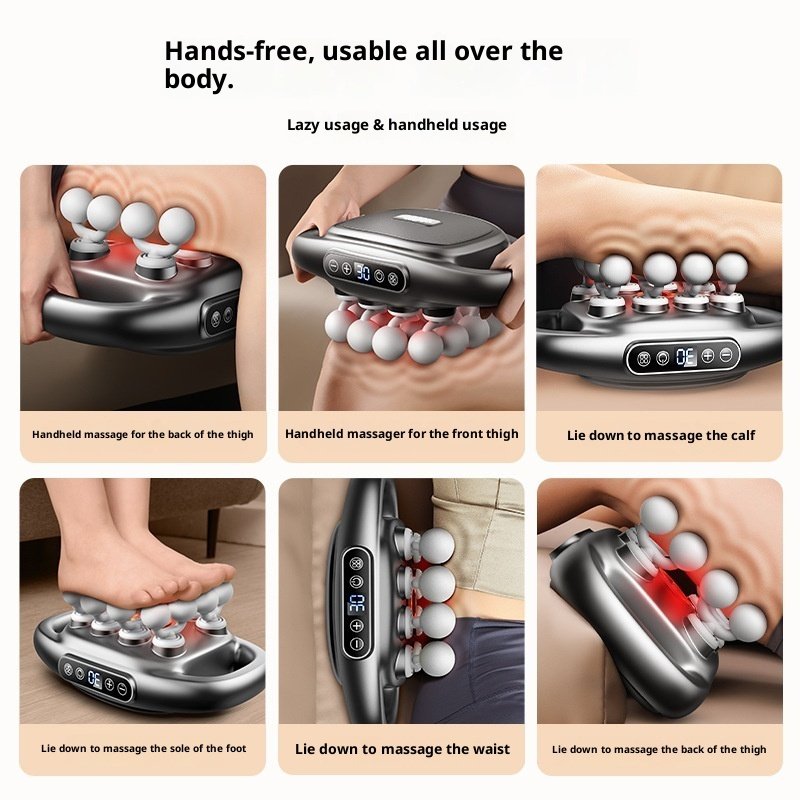
4. Electric Neck and Shoulder Massager
Exercise builds strength, but it also builds tension especially in the upper back, neck, and shoulders. If you work a desk job alongside your fitness routine, this tension compounds quickly and leads to headaches, poor posture, and disrupted sleep.
An electric neck and shoulder massager applies kneading pressure that mimics the technique of a professional massage therapist. Infrared heat penetrates deeper into muscle tissue than surface massage alone, relaxing the connective tissue around your cervical spine and upper trapezius.
When to use it for best results:
- After every upper body workout session
- After long periods of sitting at a desk
- Before bed to reduce overnight muscle tension
- During rest days as active recovery
Many models are wireless and hands-free, meaning you can use them while reading, watching TV, or resting – no effort required on your part whatsoever.
5. Digital Fitness Scale with Body Composition Tracking
Tracking progress is one of the most powerful motivators in any fitness journey. A smart digital scale goes beyond simple weight measurement to estimate body fat percentage, muscle mass, bone density, and hydration levels.
Understanding your body composition matters more than your weight alone. Someone who gains 2kg of muscle while losing 2kg of fat will weigh exactly the same on a basic scale – but their fitness has dramatically improved. A body composition scale shows you this progress accurately.
Metrics worth tracking:
- Body weight (obvious but important for trend analysis)
- Body fat percentage (more meaningful than weight alone)
- Muscle mass (shows if your strength training is working)
- Hydration level (dehydration tanks performance and recovery)
- BMI as a general health reference point
Pro tip: Always weigh yourself at the same time of day, ideally first thing in the morning after using the bathroom and before eating. This gives the most consistent readings over time.
6. Foam Roller for Deep Tissue Stretching
Flexibility and mobility are the most neglected pillars of fitness. Most people focus entirely on strength and cardio, then wonder why they feel stiff, move poorly, and get injured regularly.
A foam roller addresses this directly through a technique called self-myofascial release. By applying sustained pressure to tight muscle groups, it breaks up adhesions in the fascia – the connective tissue that wraps around every muscle – restoring normal movement and reducing pain.
Best foam rolling routine for fitness:
- Calves and hamstrings: 60 seconds each after lower body sessions
- IT band (outer thigh): 60 seconds each side for runners and cyclists
- Thoracic spine (upper back): 90 seconds to counteract desk posture
- Quadriceps: 60 seconds before squatting to improve depth
- Lats (under armpits): 60 seconds each side after pulling exercises
Foam rolling before a workout increases tissue flexibility and reduces injury risk. Rolling after a workout speeds up recovery and reduces next-day soreness. Five minutes morning and evening makes a noticeable difference within two weeks.
7. Adjustable Jump Rope with Weighted Handles
Once you have mastered basic skipping, a weighted jump rope with adjustable handles takes your cardio and upper body conditioning to the next level. The added weight in the handles engages your shoulders, arms, and core throughout every rotation, turning a pure cardio tool into a full-body conditioning exercise.
Weighted ropes are commonly used in CrossFit, boxing, and high-intensity interval training (HIIT) programmes because they combine cardiovascular effort with muscular endurance work simultaneously.
Sample HIIT workout using a weighted rope:
- 30 seconds skipping at maximum speed
- 15 seconds rest
- Repeat 8 times (4 minutes total)
- Rest 60 seconds
- Repeat the full circuit 3 times
This 15-minute workout burns significant calories and builds serious cardiovascular fitness – no gym, no machines, no excuses.
Building Your Home Gym: Where to Start
If you are buying your first pieces of home fitness equipment, start with the resistance bands and skipping rope. These two items alone give you cardio, strength, and flexibility training capability for under £30 combined. Add the massage gun or neck massager once you are training consistently and need to prioritise recovery.
The most expensive gym in the world cannot replace consistency. A simple setup at home that you actually use every day beats a premium membership you rarely visit.
The basic starter kit looks like this:
- Resistance band set → strength and mobility
- Skipping rope with counter → cardio and coordination
- Neck/shoulder massager → recovery and relaxation
That is genuinely all you need to get started and stay consistent.
Final Thoughts
Getting fit does not require expensive equipment, a personal trainer, or hours of free time. It requires the right tools, used consistently, with a clear plan. The seven gadgets above cover every aspect of a well-rounded fitness routine – training, cardio, recovery, and progress tracking.
Every product mentioned in this guide is available at budget-friendly prices without compromising on quality or results.